













Sense
Notice what your systems never wrote down. Meetings, market feeds, and field signals, captured, confidence-scored, and linked back to source.
SERAA PULZE →We are happy to work with leading financial services firms, insurers, manufacturers, retailers, real estate brands, transport operators, agribusinesses, and professional services firms across the globe.
Most enterprises today have dozens of AI initiatives and almost no AI in their operating models. Covasant SERAA is the intelligent layer that turns fragmented investment into intelligence that understands your business, reasons about your business goals, acts inside your systems under real governance, and gets better every time it runs, in our cloud, in your VPC, or fully air-gapped on your own hardware.
Traditional automation follows steps somebody wrote in advance. Agentic systems pursue a business outcome and work out the steps themselves, which is a different thing to buy, and a different thing to govern.
Real enterprises have complex workflows. Data sits in forty systems. Workflows cross six departments. Decisions carry consequences and regulators. An AI model that dazzles in a sandbox meets none of that.
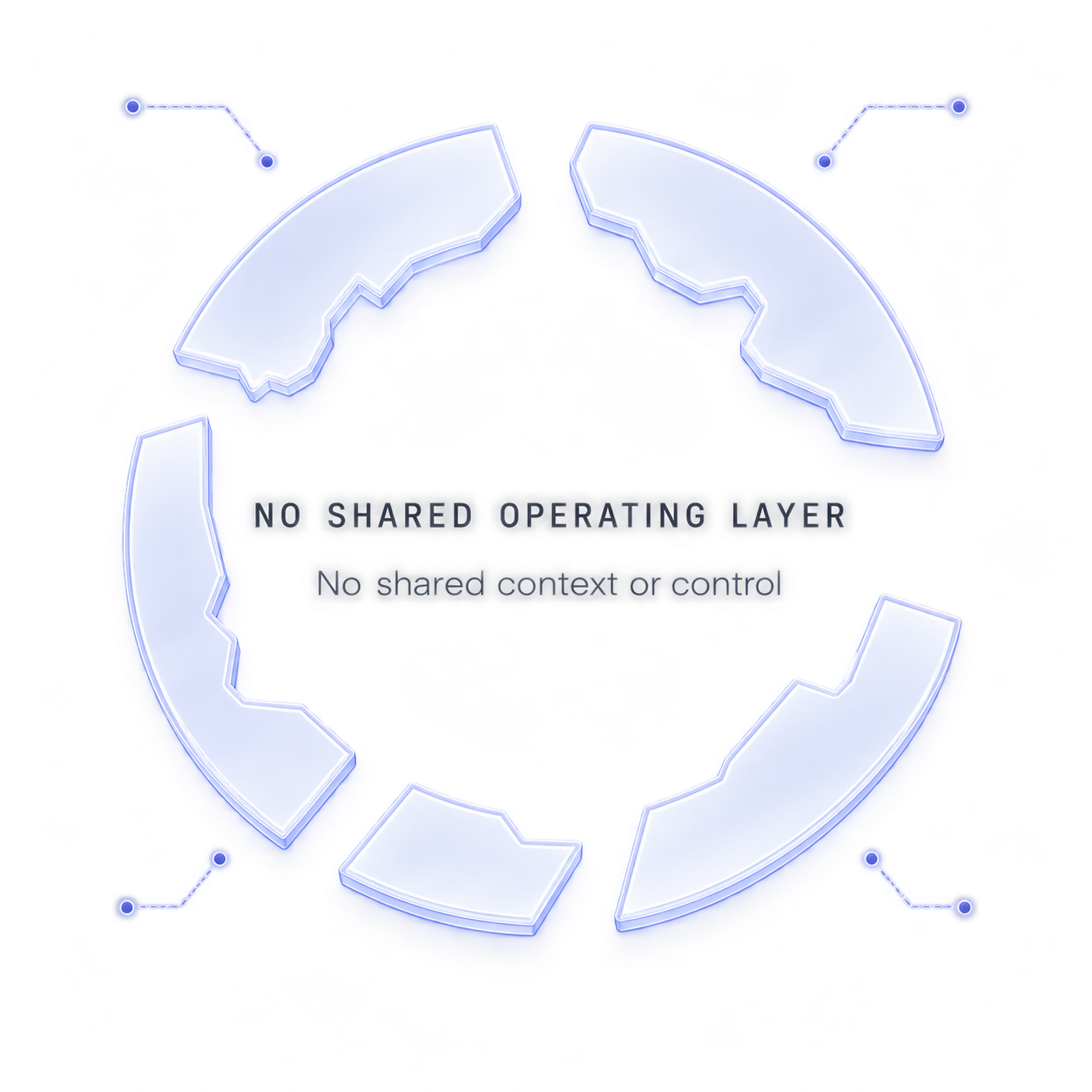
Different definitions, owners, and data.
Humans stitch work across tools and teams.
Policies, access, and audit vary by team.
Hard to track value or prove outcomes.
One model of your data, processes, and goals.
Act inside the tools and workflows that run your business.
Impact you can see. Value you can prove.
Five things intelligent action needs, in the order it needs them. Four products, and one governance layer across all of them. Each layer stands alone and pays for itself. Most enterprises start with one, and every one of them runs inside a perimeter that you choose.
Notice what your systems never wrote down. Meetings, market feeds, and field signals, captured, confidence-scored, and linked back to source.
SERAA PULZE →Reason across everything you already own. SQL, vector, and graph retrieval composed into one chain, with the audit trail attached to the answer.
SERAA AXON →Keep what worked, once a person approves it. A layer hierarchy that mirrors your org, with a reviewer between what the system notices and what becomes shared knowledge.
SERAA SYNAPSE →Do the work, under a policy that holds. Build, orchestrate, register and monitor every agent, on every cloud, from one control plane.
SERAA CORTEX →Answer for every one of them. Scope-based access control and evidence across all four layers, in whichever perimeter your regulator demands.
EGI is not one giant model. It is an enterprise that continuously understands its own business, reasons across its own context, executes its own work, learns from what happened, and adapts how it operates, without a transformation programme every time the world moves.
Every outcome makes the enterprise smarter.
Covasant SERAA is not a monolith you buy whole. Each component is a product in its own right, with its own buyer, its own business case and its own deployment path, and a shared context interface, so the ones you add later compound instead of collide. Start where the pain is. Most enterprises start with one.
What your best rep knows, everywhere.
The tribal knowledge trapped in meetings and market noise, captured and put to work. Two editions on one architecture, SalesPulze for revenue teams, MarketPulze for brand and competitor sentiment. Run it on its own for functional ROI, or pipe its signal straight into SERAA Axon and SERAA Synapse.
Ingests meetings, social feeds, industry publications and filings into one signal layer, alongside the systems you already run.
Confidence-scored, evidence-linked output rather than a black box, every insight traces back to its source.
Live coaching signal generated from every customer conversation, surfaced back to the rep in the moment.
Signal is written to SERAA Synapse and made available to SERAA Axon automatically, no manual hand-off.
Ask your company a question. Get your company’s answer.
The enterprise reasoning layer. Axon connects your ERPs, CRMs, data lakes, documents and IoT streams into one semantic layer, then answers the questions leadership actually asks — in real time, with full explainability. Not a BI tool. It reasons.
100+ connectors to SAP, Oracle, Salesforce, lakes, IoT and unstructured archives — fused into one semantic layer.
SQL, vector and graph combined in a single chain — defined in natural language, verified by admins, run with deterministic guardrails.
Agent-governed MDM applies rules written in plain English and builds continuously improving Golden Records. Clean data isn't a prerequisite to start.
Semantically scans thousands of contracts and regulatory texts in seconds, surfacing obligations keyword search misses.
A complete reasoned audit trail at every decision node. No unverified AI action is taken. Built for regulated industries.
Nothing becomes company knowledge until a person says so.
Hierarchical memory infrastructure for enterprise AI. A flat vector store is not an enterprise memory — enterprises aren’t flat. Synapse gives every tenant a Layer hierarchy that mirrors their real structure, and puts a human between "the AI noticed something" and "this is now shared knowledge."
Tenant-defined Layers — Tenant → Project → Enterprise Memory → Layers. Retrieval is scoped to a Layer path, so one branch's local exception can't leak into another region's answers.
Static Layers hold documents you upload, indexed immediately. Adaptive Layers mine patterns from real conversations that recur across enough distinct people and sessions.
Observe → Detect → Review → Promote → Record. A reviewer sees the exact text that would be written, never a paraphrase, and can edit, approve, reject or later demote it.
Self-service portal, a playground with a full Layer trace, a governance queue, a click-to-explore Mind Map, and an audit trail scoped to a single Enterprise Memory.
Every agent you run. One screen. One switch.
The operating system for the enterprise agent lifecycle. Four modules carry an agent from first build to live production, each handing off to the next, Agent Work Bench, Registry and Control Tower are also available standalone, so you can govern an agent estate you built elsewhere.
No-code and pro-code agents in one interface. Model Hub with 100+ LLMs, an MCP Hub for tools, and a playground for model-by-model validation before deployment.
Visual drag-and-drop canvas for sequential chains and parallel branches. A2A protocol support so third-party agents compose natively, with a different model per stage.
Universal catalogue, auto-discovered from Gemini Enterprise, Azure AI Foundry, Bedrock and AgentBricks. Dev → QA → Staging → Production with gates, deploying to GKE, AKS, EKS or Agent Engine.
Builds a high-fidelity simulation from your own historical logs and stress-tests the agent before a single real request reaches it — scored on faithfulness and context precision.
Cost attribution by agent, model and provider. A full audit log of every LLM call. Content and PII guardrails at runtime, plus an instant kill switch for any agent, on any cloud.
Every component ships with its own licence, its own scopes and its own deployment plan, so procurement buys one thing and one team owns it. Nothing forces a second purchase. What changes when you add the next one is that they stop guessing at each other, SERAA Pulze’s signal lands in SERAA Synapse, SERAA Axon reasons over the Golden Records beneath it, SERAA Cortex’s agents read the same memory instead of starting cold. Sequence it to your business case, not to ours.
Scope-Based Access Control organises every resource around three nested scopes that mirror how enterprises already operate. Assets flow up. Infrastructure flows down.
Governance teams always see everything built beneath them. Teams below can never depend on assets being curated above them, or reach for capability their parent has not granted.
Not one idea stretched across four products, each layer earns its place against the tools that already claim to do this.
What was said in the meeting and what the market is doing right now never enters a system of record. SERAA Pulze captures it and reasons over it alongside your ERP data.
SQL for structured precision, vector for document meaning, graph for relationships, composed in a single reasoning chain with the audit trail attached.
A Layer hierarchy that matches your org, adaptive learning from real usage, and a reviewer who sees the exact text before it becomes shared knowledge.
One catalogue, one policy engine and one cost view across agents on GKE, AKS, EKS and Agent Engine, discovered from four vendor platforms, whoever built them.
Generic analytics doesn’t understand your supply chain. Pre-built intelligence models and domain ontologies connect the systems you already run.


Forward-deployed engineers and strategists embed with your team, stand Covasant SERAA up inside your perimeter, and prove the first workflow. Then they hand it over.
The executives transforming their organizations with Agentic AI are asking harder questions and demanding better answers. These are the reads that help you get there faster.
ISO/IEC 42001:2023 is the governance standard separating enterprises that build AI they can stand behind from those building AI they cannot control. Every CIO and CRO considering enterprise AI deployment needs to understand what this standard demands and what it protects.
Most organizations today launch AI solutions but lack the governance to sustain them. ISO/IEC 42001:2023, the world's first international AI Management System (AIMS) standard, provides a structured framework for governing AI responsibly across risk assessment, ownership, monitoring, and ethical alignment. With the EU AI Act fully applicable by 2026, organizations that implement ISO 42001 now are building the governance infrastructure that regulators and enterprise customers will soon require.
Read the perspectiveYour AI investment is in place. The pilots ran well. But returns are stalling. These three systemic problems explain why, and all three are solvable with the right platform architecture.
Read moreDiscover how building a strong foundation for data observability helps identify issues early, maintain data integrity, and create AI systems that you can truly trust.
Download the White PaperBring us one question your data can't currently answer, or one agent estate nobody can currently see. We'll tell you which of the five layers you actually need first, and which you don't.